





Permit Expediter vs. Doing It Yourself: Which Is Better for Your Texas Construction Project?
By Ana Abascal, Permit Coordinator and Founder of AA Permit Solutions
If you are planning a construction project in Texas, you may be deciding whether to manage the permit process yourself or work with a permit expediter.
For a small, straightforward project, handling the application independently may be practical. For projects involving multiple permits, detailed plans, several reviewing departments, or a demanding construction schedule, professional permit coordination may reduce administrative work and help you move forward with greater clarity.
The right choice depends on your project scope, experience, available time, and local requirements.
Most importantly, Texas does not have one single statewide building-permit process. Requirements are established primarily by the city or county with jurisdiction over the property. Permit requirements, processes, fees, documents, and review timelines vary by jurisdiction and project scope.
Texas Permits Start With the Local Jurisdiction
Before deciding who should manage your permit, identify the authority responsible for the property.
A project may fall under:
· A city building or development services department
· A county development or engineering office
· A fire department or fire marshal
· A public works or right-of-way department
· A state agency for certain environmental or accessibility requirements
· Multiple agencies reviewing different aspects of the same project
A property inside city limits may follow city procedures. A property in an unincorporated area may be subject to county requirements, local development rules, or limited permit requirements depending on the county and project.
For example, the City of Austin’s residential permit guide identifies project-specific factors such as zoning, floodplain status, trees, historic districts, site development, trade work, and right-of-way improvements. These factors can affect the documents, reviews, fees, and approvals required.
The first step is always:
Property location → Jurisdiction → Project scope → Required permits
What Requires a Building Permit in Texas?
There is no single answer that applies to every Texas property. Local requirements may differ, but permits are commonly required for work such as:
• New construction
• Additions and expansions
• Structural alterations
• Removing or modifying load-bearing walls
• Garage conversions
• Significant kitchen or bathroom remodels
• Foundation repairs
• New decks, patio covers, or exterior structures
• Demolition
• Electrical, plumbing, or mechanical work
• Changes to building use or occupancy
• Commercial tenant improvements
• Site, drainage, driveway, or right-of-way work
Some cosmetic work, such as painting, flooring replacement, or cabinet replacement, may not require a building permit in a particular jurisdiction. However, the answer can change if the work affects structure, plumbing, electrical systems, HVAC, occupancy, setbacks, or the building footprint.
A useful starting point is AA Permit Solutions’ guide to what requires a building permit in Texas. You should still confirm the current requirements with the authority having jurisdiction before beginning work
Option One: Handling the Permit Yourself
An owner or contractor may be able to manage permitting independently when the project is limited, the jurisdiction is familiar, and the applicant has time to coordinate the process.
DIY permitting may be reasonable when:
· The project is small and clearly defined
· Only one jurisdiction is involved
· The required plans and documents are already complete
· The work does not involve unusual zoning, site, or environmental conditions
· You understand the local submission process
· You can respond promptly to correction notices
· You can coordinate inspections and permit closeout
· The local jurisdiction allows you or your contractor to act as the permit holder
For example, a contractor who regularly works in the same city may already understand the department’s portal, application forms, registration requirements, plan standards, and inspection procedures.
An owner-builder may also be allowed to apply directly in some jurisdictions. However, local rules may limit owner-issued permits to certain properties or circumstances, such as a primary residence. Separate trade permits may also require licensed professionals.
The
City of Fort Worth’s residential permitting information and Austin’s application guidance demonstrate why applicants should review local rules before assuming that any owner or contractor can pull every permit.
The responsibility remains with the applicant
Managing a permit independently does not eliminate responsibility for:
· Correct project information
· Complete and accurate plans
· Code compliance
· Contractor registration
· Licensed trade work
· Permit fees
· Required inspections
· Approved revisions
· Final approval or certificate of occupancy, when applicable
If the project changes after submission, the approved plans and permit may need to be revised. Beginning work before required approvals are in place may lead to stop-work orders, additional reviews, penalties, rework, or complications during a future sale or refinance.
Option Two: Working With a Permit Expediter
A permit expediter, also called a building permit expediter or construction permit expediter, is a private professional who coordinates the administrative path between the project team and the local authority.
A permit expediting service does not replace the city, county, architect, engineer, contractor, or licensed trade professional. The expeditor helps organize communication and process management so the project team can focus on design, construction, clients, and operations.
Depending on the engagement, a permit expediter may help with:
1. Jurisdiction and scope review
Identifying the likely permitting authorities and reviewing the proposed work.
2. Application preparation
Organizing application forms, project descriptions, plan sets, contractor information, and supporting documents.
3. Pre-submission plan audits
Reviewing the submittal package for missing information, inconsistencies, and common compliance issues before submission.
4. Municipal filing and liaison
Submitting applications through the required portal or process and serving as an authorized point of contact.
5. Review tracking
Monitoring application status, department comments, outstanding fees, and required actions.
6. Correction coordination
Communicating review comments to the owner, contractor, architect, or engineer and helping organize responses.
7. Permit issuance and closeout
Tracking approval, final documents, inspections, revisions, and closeout requirements when included in the scope of service.
A permit expediter cannot guarantee that a city will approve a project, waive requirements, or meet a particular timeline. The reviewing authority controls its own decisions, procedures, fees, and workload. Professional coordination can, however, make the process more organized and reduce avoidable administrative errors.

When Is Professional Permit Coordination Helpful?
A permit expediting service may be especially helpful when:
· The project includes several permit types
· Multiple departments or agencies are involved
· The property has zoning, floodplain, historic, tree, drainage, or access considerations
· The project includes structural, electrical, plumbing, or mechanical work
· A commercial space is changing use
· The project involves a restaurant, retail suite, office, medical space, or mixed-use building
· The construction schedule depends on timely permit progress
· The owner or contractor is unfamiliar with the local jurisdiction
· The application has already received correction comments
· The project requires revisions, resubmissions, or multiple approvals
· The project team does not have staff available for repeated municipal follow-up
Commercial and industrial projects may require more extensive documentation than a typical residential application. Commercial submissions can involve architectural and engineering plans, accessibility review, fire protection, site development, energy documentation, health department coordination, or change-of-use approvals.
Industrial and large-facility projects may also involve high-load structures, warehouse layouts, fire and life-safety requirements, environmental considerations, specialized equipment, or stormwater compliance.
For construction activities that disturb one or more acres of soil—or that disturb less than one acre but are part of a larger common plan of development that will disturb one acre or more—the Texas Commission on Environmental Quality’s construction stormwater requirements may apply. Regulated construction activities may require coverage under the Construction General Permit and development and implementation of a Stormwater Pollution Prevention Plan before construction begins. Applicability depends on the project, disturbed area, common plan of development, discharge conditions, and site-specific circumstances.
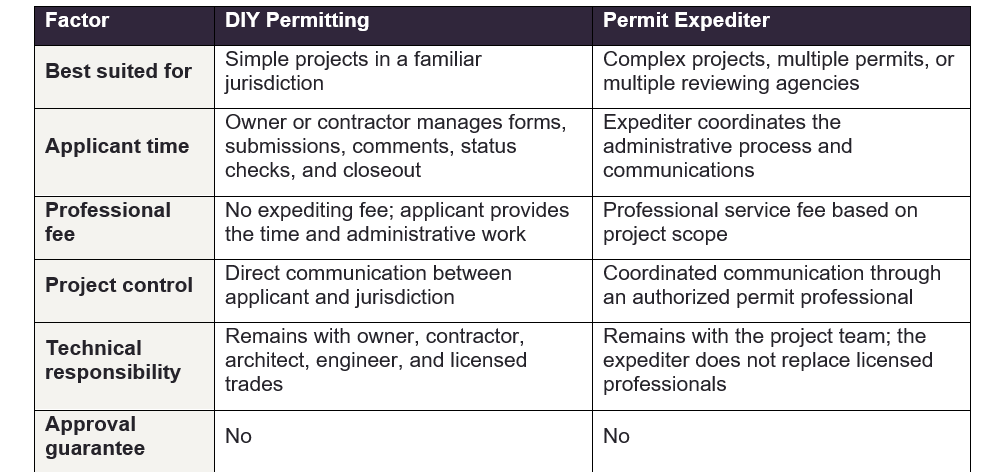
DIY vs. Permit Expediter: A Practical Comparison

The choice is not always all or nothing. Some owners and contractors handle simple permits independently and bring in a permit expediter when a project becomes more complex. Others use professional coordination from the beginning to establish a clear process and reduce interruptions.
How AA Permit Solutions Supports Texas Projects
AA Permit Solutions helps bridge the gap between architectural plans and active construction sites. Our team supports owners, contractors, architects, engineers, developers, and business owners with organized permit coordination across residential, commercial, and industrial projects.
Residential permit services
We help coordinate permits for projects such as:
· Home additions
· Major remodels
· Garage conversions
· Pools and outdoor improvements
· Structural changes
· Kitchen and bathroom renovations
· Accessory structures
Learn more about residential permit services.
Commercial permit services
We support:
· Retail and office tenant improvements
· Restaurant and café remodels
· Change-of-use projects
· Commercial interior reconfigurations
· Restroom, kitchen, and accessibility improvements
· Multi-tenant and mixed-use spaces
Explore commercial permit services.
Industrial permit services
We help coordinate permitting for:
· Warehouses and distribution centers
· Facility expansions
· Workshop and light-industrial spaces
· High-pile storage areas
· Loading areas and dock modifications
· Industrial support and ancillary spaces
Review our industrial permit services.
Our process is structured around:
Plan review → Application preparation → Municipal submission → Comment tracking → Approval coordination
Which Option Is Better for Your Project?
Doing it yourself may be appropriate when the project is simple, the requirements are clear, and you have the time and experience to manage every step.
A permit expediter may be the better fit when the project is complex, multiple approvals are involved, the schedule is important, or municipal coordination is taking you away from higher-priority work.
There is no universal answer. The best approach is the one that matches your project scope, jurisdiction, resources, and risk tolerance.
Before construction begins, confirm:
· Which authority has jurisdiction
· What requires a building permit
· Whether trade permits are needed
· Which plans and documents are required
· Who may act as the permit holder
· What fees apply
· What inspections and closeout documents are required
· Whether state or environmental approvals apply
Clear requirements. Organized submissions. Fewer avoidable delays.
Let’s Talk About Your Project
If you are unsure whether to manage the permit yourself or work with a construction permit expediter, AA Permit Solutions can help you identify the likely requirements and next steps.
Contact AA Permit Solutions, fill out the form, or call 713-428-2321 to discuss your residential, commercial, or industrial project.
We will help you organize the process so you can move forward with greater clarity and confidence.
*Permit requirements, fees, documents, review procedures, and timelines are determined by the applicable jurisdiction and may change based on project scope, site conditions, code requirements, and agency review. This article is for general information and is not legal, architectural, engineering, or code-compliance advice. Confirm current requirements with the city or county having jurisdiction over your property.*
Fast Permit Approvals in Texas
We handle permits, plans, and city coordination, so your project moves forward without delays.
Recent Posts